Choosing what to build
In shortLet obviousness pick the idea and a real test pick whether it feels right, then let the outside world pick the price.
On 8 June, Claude brought me three app ideas. They were properly worked: mockups, specs, pricing tables, a verdict on whether the platform's APIs could do each one. Thorough work.
My reply: "I don't really understand them… we will do this same exercise every week until an obvious app comes."
That line became a standing rule in the studio. It's also the most art-led decision I make. Choosing what to build isn't something I score. I wait until an idea is obvious, and then I trust it.
But this post sits just on the art side of the middle, not at the art end. The gut picks the idea. Something else has to pick the price.
The gut picks
Building is cheap now. I design with Claude, so the scarce skill isn't building. It's knowing which few things deserve to exist, and letting the rest go.
I've built around 30 products as a solo studio: apps, client tools, internal automation. I chose to ship 5 of them. Every one of those calls was judgement.
The test for obvious is simple. An idea has to fit in one plain sentence: what it does, for which real business owner, and what they'd pay for it. No platform jargon. If I don't get why someone buys it on the first read, it goes back in the backlog.
And the default isn't to build. After each weekly scan, ideas go into a backlog, one plain sentence each, and they stay there until one of them is obviously right to me. That's the point.
Feel it before you build it
On 13 November I had an idea of my own. A visitor shakes their phone, a snow globe on the page swirls, and as the snow settles it shows whatever the shop owner hid inside: a discount code, a message, a photo. It's called Shake n Show.
The written first check was a feel test. Before any app: one plain web page with the globe, opened on my iPhone and an Android phone, to see whether the shake feels good. No app until it does.
So the globe got drawn in six art styles, and the set went through several rounds of my notes: no stark black outlines on the cartoon style, snow in every scene, dark styles that don't look cartoony, a dark mode that isn't washed out. Claude proved the plumbing separately on a private test site, so coupons could land in a basket, but that was a test harness, not the product. On 20 November the shake worked on my own phone. It opens up possibilities.
Then the receipt
Here's where science takes over. On 10 November I said yes to a fifth check on the list Claude runs before anything gets built: who pays, and what do they pay today?
Before building anything meant to earn, name the market it sells to and look at that market from the outside: who already sells to it, at what price, and how big it is. Write the answer down. If nobody can be named who pays for something like it today, say so plainly before building. A free pilot is allowed, but it's recorded as one, with the market it's meant to prove.
The reason was a count. That day, 11 of the 13 markets the studio builds for had never been looked at from the outside. A few hours of desk research the same day changed three decisions: where one of our products really stands in its market, what public bodies actually pay for that kind of service, and selling field-service work as a custom build rather than as another app.
The checks cut both ways. On 15 November I said of another idea, "log it. build it. let's not waste time." The first check, prove nothing new is needed, stopped it the same day: the platform was already doing the job on every site we looked at, with nothing for the owner to set up. A same-day look saved a build.
Shake n Show has passed the gut and the phone. Its who-pays line still reads "not researched", with the comparison named: what shop owners pay today for scratch-card and spin-to-win promo widgets. That's the next step, and it's the one that sets the price.
Here's the whole gate. Try it with an idea of your own.
The rule
Let obviousness pick the idea and a real test pick whether it feels right, then let the outside world pick the price.
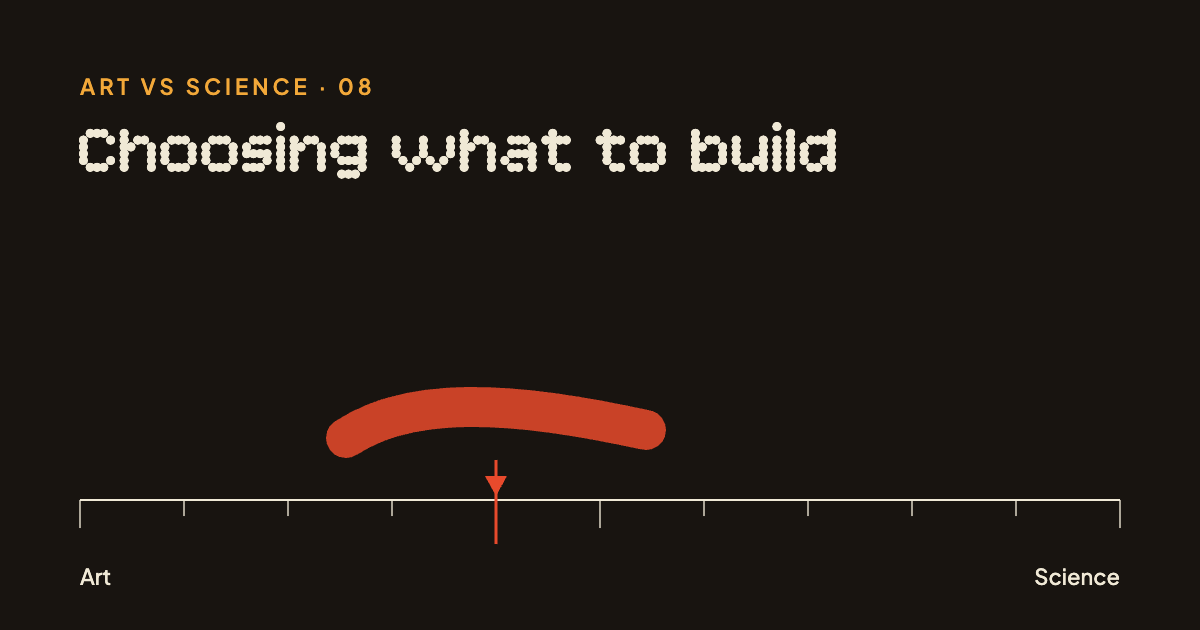
On the ruler, this post sits at 40: the gut leads, and a receipt follows it in. The last post, at 43, says plainly where the line between art and science sits, and how every bad day turned into a check that's still running.