
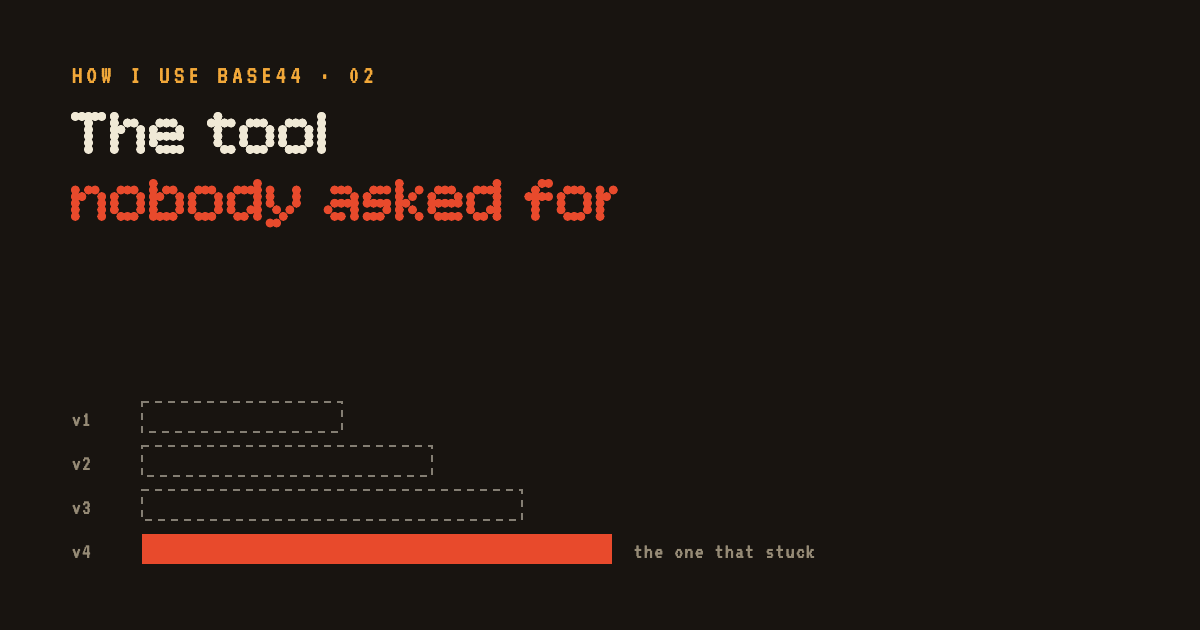
The tool nobody asked for
In shortFour versions in a month is not indecision. It is the price of learning being cheap.
The apps that get written about are the ones with customers. The apps that quietly pay for themselves often have none — they are the ones a business uses to run itself.
This is about one of those, and about the month it took to find out that the first version was wrong.
A method living in three places
A small agency runs everything on its own method: a discovery at the start of a project, then the work, checked against what the client actually hired them for.
The method was real. Where it lived was the problem — a shared Google Sheet for goals and contractor hours, reports written in Google Docs, call transcripts in a folder. Individually fine. Together, nobody could answer the only question that matters: is this week's work pointed at the thing the client is paying for?
I built the dashboard nobody asked for. The first working version existed the same day we decided what it was.
Objectives
Pipeline
This week's actions
The fourth version: objectives, the pipeline alongside, and the actions under them.
Four versions in a month
Then the interesting part started, which is that using a thing teaches you what it should have been.
- Version one was the plan. Projects, goals, tasks, and a score.
- Version two came after the first real week of use: clearer projects, a tidier switch between the pipeline and the detail.
- Version three came from the person who would actually live in it saying she wanted it to face her clients rather than her own team.
- Version four came from one comment, mine, looking at the live page: this doesn't feel intuitive, we need a much clearer workflow.
That fourth version is the one that stuck, and what changed was not decoration. The whole thing became a plan: objectives, then the actions that serve them, with the pipeline from first conversation to delivered work running alongside. The score went, because a number that rewards having goals rewards having more goals, which is the opposite of what the agency wants.
None of that came from a requirements document. It came from using it and disliking something specific.
The part I got wrong
I wrote the requirements. I still got the workflow wrong.
That is worth saying plainly, because the usual reason internal tools fail is that they are built from an imagined version of someone's day. You cannot design your way around that. You find out by putting it in front of a person, watching which screen they hesitate on, and changing it before the hesitation becomes a habit.
The thing that makes that possible isn't cleverness, it's distance. On a normal stack, "this doesn't feel right" becomes a scoping conversation. Here it becomes an afternoon. Four versions in a month is not indecision; it is the cost of learning being low enough for it to be worth doing.
Permissions are product, not settings
The dullest-sounding part of this app turned out to be the part that matters most.
A login only exists once a member record matches the person's email address. That sounds like plumbing. What it means in practice is that adding somebody to the team is a deliberate act, not a side effect of them finding the URL. Two of the three people in the agency can sign in today; the third has a record with no email on it yet, so she can't — and that is visible rather than mysterious.
The client-facing view exists and is deliberately unopened. No client gets a login until the commercial terms are agreed in writing. That is a product decision about what kind of company you are, and it has to be made before the first invite, not after the first complaint.
The next thing asked for was a directory of specialists the agency could bring into a job. That shipped as a page. The jobs board behind it has not been built, and the review tool I started was paused on purpose, because the workflow needed rethinking before more screens were added to it.
Saying that out loud is part of the product. A tool that only claims finished features is a tool nobody trusts.
What this way of building is actually for
Internal tools are where an app builder earns its keep, and they are also where it is easiest to fool yourself, because you are the only customer and you already know how it works.
So: build the thing that answers one question, put it in front of the person who will use it, and expect the first version to be wrong. Then make being wrong cheap.
Two of the things in this series started as products. This one started as a spreadsheet problem, which is how most of the useful ones start.
Send the brief.